The Challenge & Support Model
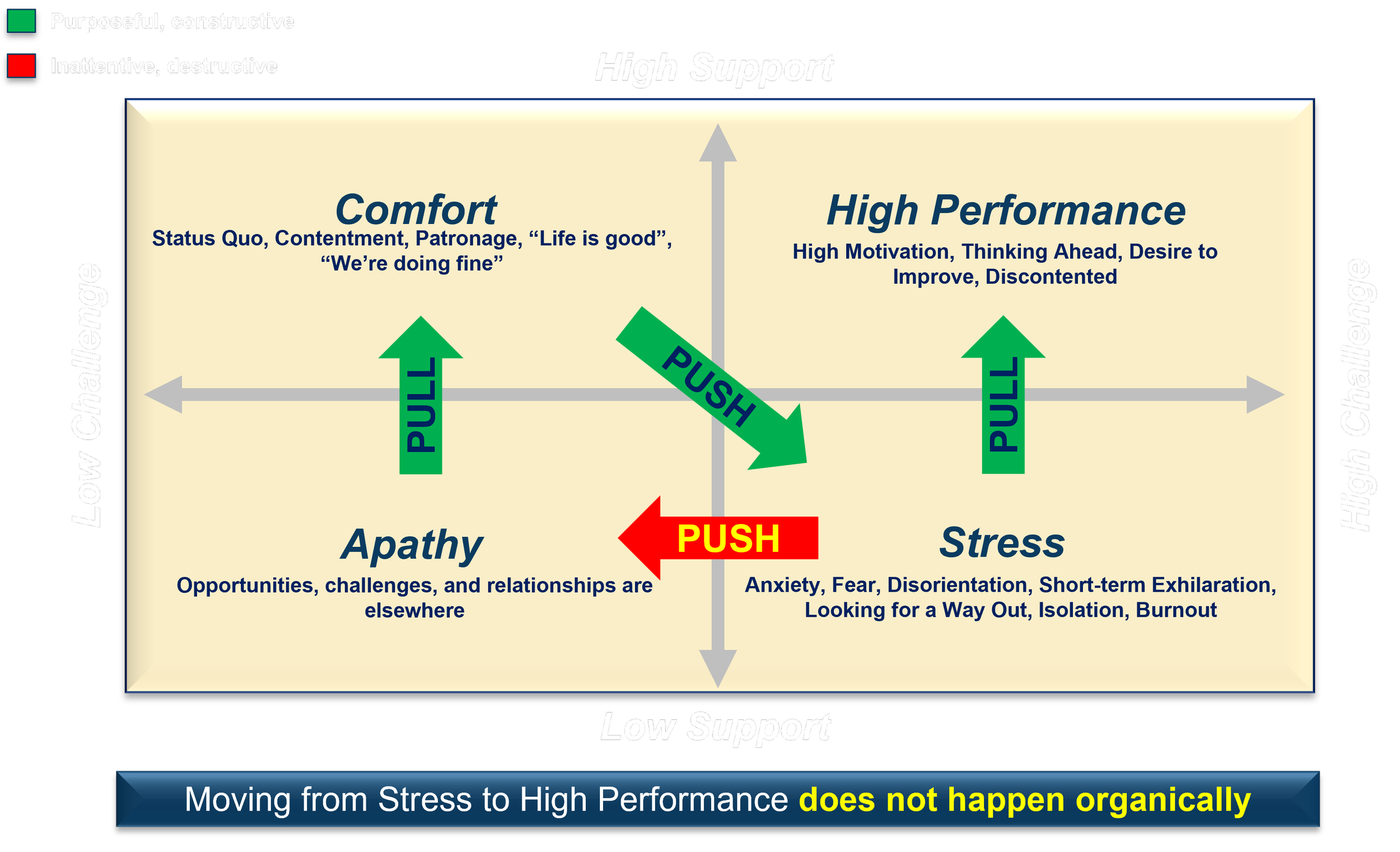
This is a concept originally developed by Frederick Herzberg in the mid-1960s in his “Two Factor Theory” and expanded by Nevitt Sanford in his theory on “Challenge & Support”, which also originated in the 1960s. The model suggests that people will not move to higher levels of performance as long as they are rewarded for current levels of performance, unless acted upon by an “external force” – the leader setting higher expectations and only rewarding the behaviors that produce higher results.
The model is built around an “X-Y” axis with the horizontal line representing Expectations – from low to high – and the vertical line representing Support – from low to high. Expectations are things like achieving goals, targets, and key performance metrics. Support is things like rewards, recognition, skill development and coaching. These two axes produce four quadrants.
Leaders of change must employ specific and purposeful actions to PUSH people out of their Comfort Zone into Stress. People generally don’t move voluntarily.
Leaders of change must also employ clear and purposeful PULL actions that will help lift their people out of Stress and into High Performance. Moving from Stress to High Performance does not happen organically.
The lower left quadrant is Apathy, which results from leaders providing Low Expectations for results and outcomes, and Low Support for achieving them.
The upper left quadrant is Comfort, which results from leaders providing Low Expectations for results and outcomes, and providing High Support for current levels of achievement.
The lower right quadrant is Stress, which results from leaders providing higher Expectations for results and outcomes, and no longer supporting the current level of achievement.
Finally, the upper right quadrant is High Performance, which results from leaders providing higher Expectations for results and outcomes, and only providing Support for people as they drive to achieve the new goals and improved results.